The Opportunity
A Multi-Hundred-Billion-Dollar Market Is Being Built Right Now
The global EV charging infrastructure market was valued at roughly $40–48 billion in 2025 (Grand View Research estimates $40.2B; Precedence Research puts it at $47.6B). Depending on whose forecast you trust, it’s headed to somewhere between $113 billion and $415 billion by the early-to-mid 2030s, with compound annual growth rates consistently in the 22–27% range.[1][2] The consensus is clear: this is one of the fastest-growing infrastructure sectors in the world.
In the US alone, the charging market is growing at over 30% annually. The number of public DC fast-charging ports jumped 33% in 2025, from 51,000 to 67,916 as of January 2026, and has continued growing since.[3] The federal government has allocated $5 billion through the NEVI program to build out a national charging network along highway corridors, with $3.3 billion distributed to states. Rollout has been slower than planned (the program was briefly paused in early 2025 before being restored through legal action), with roughly 120–150 stations energized by early 2026 and hundreds more funded or under construction.[4]
The drivers are straightforward: EV adoption is surging globally, government incentives are substantial (the federal 30C tax credit covers up to 30% of installation costs, up to $100,000 per commercial property), fleet electrification is accelerating, and policy mandates in states like California are pushing the timeline forward.[5] Asia Pacific already accounts for 68% of the global market and is growing fastest, but North America is where the infrastructure gap, and therefore the investment opportunity, is widest.[1]
Global EV Charging Infrastructure Market Projections
Estimates from major research firms. All show 22–27% CAGR. [1][2]
To put this in context, the historical buildout of gas stations in America took decades. The EV charging network is being built on a compressed timeline, with modern advantages: software-managed pricing, real-time utilization data, and the ability to generate revenue from adjacent services. It’s not a perfect analogy, but the parallels are strong enough that major real estate firms, energy companies, and infrastructure funds are all making aggressive bets.
The Dominant Player
Tesla’s Charging Empire: From Network to Platform
Tesla doesn’t just make electric vehicles. It also operates the largest, most reliable fast-charging network in the world: 8,182 stations and 77,682 connectors globally as of Q4 2025, with over half of all US DC fast-charging ports.[6][3]
But the bigger story is what Tesla did next: it opened the network to non-Tesla EVs and started selling the hardware to businesses. That shift turns charging from a vehicle perk into a platform business, with massive implications.
Supercharger for Business
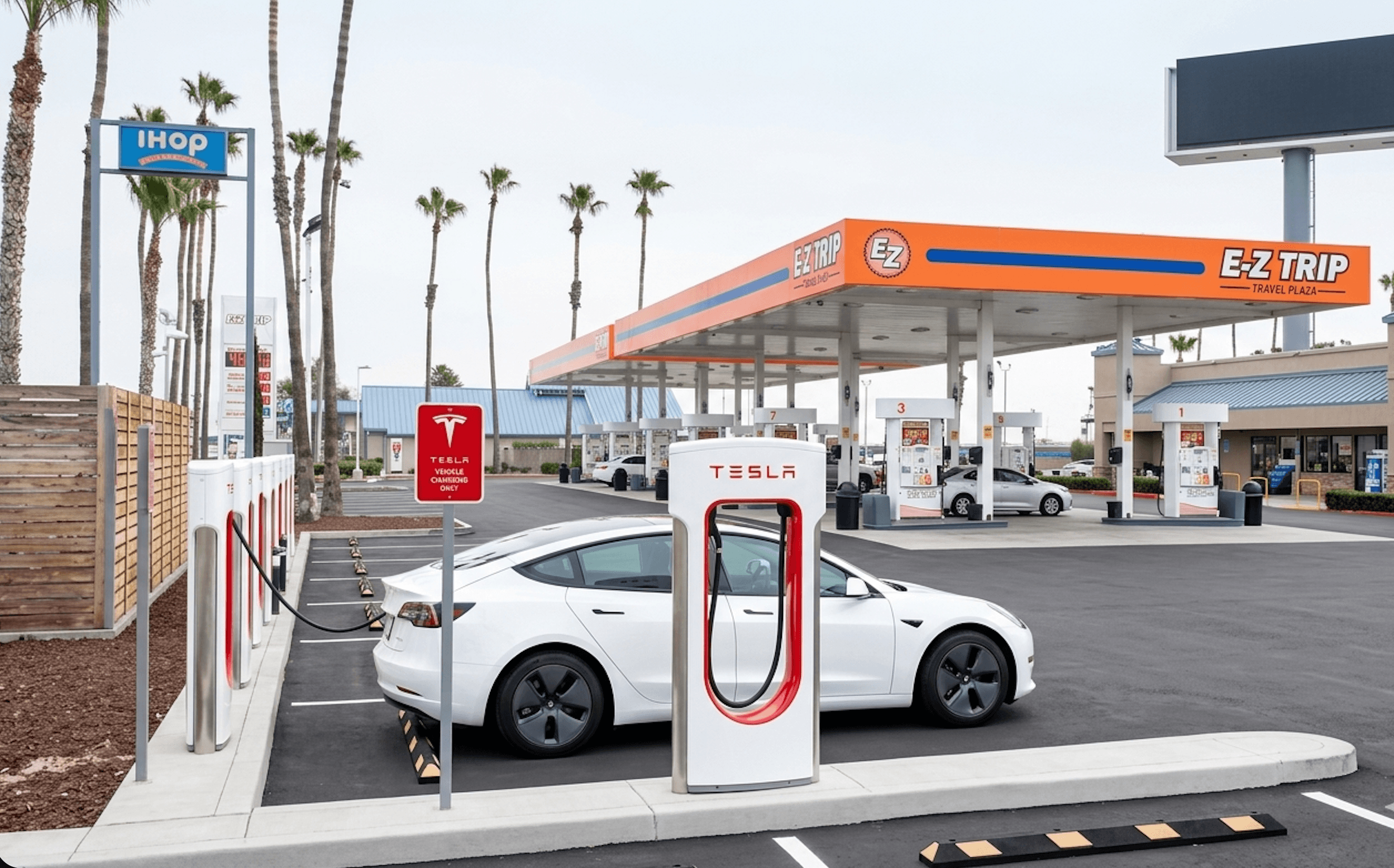
Launched in late 2025, the Supercharger for Business program lets commercial property owners buy and install Tesla’s V4 Supercharger hardware at their own sites (offices, retail centers, hotels, gas stations, convenience stores). The minimum is four stalls per site, with V4 posts rated for up to 500 kW output (current deployments typically deliver up to 325 kW, with higher speeds rolling out as vehicles support them).[7]
Here’s what makes it compelling: the business owns the hardware and sets the pricing, but Tesla manages everything else. That includes integration into Tesla’s in-car navigation and Trip Planner (so every Tesla driver gets routed to your location), real-time availability updates, over-the-air software updates, preventive maintenance, and driver support. Tesla guarantees 97% uptime, which is the highest in the industry.[7]
The stations can be fully white-labeled, meaning businesses can brand them with their own logos instead of Tesla’s. They show up on Tesla’s Supercharger map and function identically to Tesla-owned stations from the driver’s perspective.[8] The first third-party-owned Supercharger site went live in November 2025 in Land O’Lakes, Florida, operated by Suncoast Charging. It features eight V4 stalls at $0.45/kWh, available 24/7 to all EVs.[9]
Wall Connector for Business
For sites that don’t need fast charging, Tesla also offers the Wall Connector for Business program. These are Level 2 AC chargers that businesses install (through Tesla Certified Installers), with the option to set pay-per-use pricing anywhere from $0.01 to $0.75 per kWh. Tesla handles all billing and distributes 100% of revenue back to the business quarterly, charging a $0.03/kWh processing fee. If the chargers are offered for free, there’s no software fee at all.[10] This program has scaled rapidly since its November 2025 launch, with hundreds of commercial connector sites now active across the US.[10]
US DC Fast-Charging Networks: Port Count (Jan 2026)
Tesla holds 52.5% of all US public DC fast-charging ports. [3]
Why this matters for investors: Tesla is essentially creating an “App Store” model for EV charging. Businesses provide the real estate and capital. Tesla provides the technology, the driver network, and the operational backbone. The host keeps the revenue. Tesla profits from hardware sales, processing fees, and an ever-growing network that makes its vehicles more attractive. Everyone wins.
The Proof
The Utilization Graph That Proves the Model Works
The single most important data point in the entire EV charging investment thesis is Tesla’s utilization trend. It answers the question every skeptic asks: “If you keep building more chargers, won’t each one get used less?”
The answer, according to Tesla’s own data, is no. Average sessions per stall per day have climbed steadily from under 4 in 2019 to about 7.5 globally by Q4 2025 (approaching 8 during peak periods), with North American stalls consistently running higher.[11] During peak periods like Thanksgiving 2025, US stalls averaged 11.4 sessions per day.[12] This happened while the network was expanding rapidly. Tesla added roughly 13,500 new stalls in 2025, an 18% increase year-over-year, yet utilization still climbed.[6] The reason: the number of EVs on the road is growing faster than the number of chargers. And since Tesla opened its network to non-Tesla vehicles (Ford, GM, Rivian, and others), the addressable pool of customers per stall has expanded dramatically.
Tesla Supercharger Utilization: Sessions Per Stall Per Day
Despite massive network expansion, utilization per stall has doubled since 2019. [11]
The throughput numbers tell the same story from a different angle. In Q4 2025, Tesla’s global network averaged 261 kWh delivered per stall per day, up from 227 kWh in Q1 2025.[13] The network delivered a record 1.8 TWh in Q4 alone, totaling 6.7 TWh for the full year across 52 million sessions in Q4.[13] Meanwhile, the share of drivers experiencing a wait remained low, dropping from over 2% in earlier years to roughly 1% by late 2025 (about one car waiting per 100 stalls on average).[11] This combination of rising utilization and low wait times is the hallmark of a network that’s scaling efficiently: enough demand to generate strong revenue, but enough capacity to keep the experience smooth.
Tesla Supercharger Energy Delivered (TWh by Quarter, 2025)
Record 6.7 TWh delivered globally in 2025; Q4 reached 1.8 TWh and 52 million sessions. [13]
What this means in dollars: At an average session of 34.6 kWh and typical pricing of $0.35–0.45/kWh, each stall generates roughly $100–120 per day in gross revenue. Tesla-hosted sites often hit the upper end faster thanks to built-in navigation routing that sends drivers directly to available stalls.
The Numbers
Charging Station Economics: What the Numbers Actually Look Like
For anyone considering EV charging as a business or an investment, the economics break down into three categories: what it costs to install, what it earns, and how long it takes to pay back.
Installation Costs
For Level 2 chargers (the kind you’d find at hotels, offices, or retail parking lots), the total installed cost runs $3,000 to $15,000 per unit, depending on site conditions and electrical capacity. DC fast chargers, which are what highway stops and high-traffic commercial sites need, range from $80,000 to $250,000+ per port including hardware, installation, and electrical work.[14] The federal 30C tax credit can knock 30% off the bill (up to $100,000 per property) for installations that meet prevailing wage requirements and are located in eligible census tracts. This credit is available through June 2026. State rebates and utility incentives can stack on top, sometimes covering 50–80% of total costs when combined.[5]
Revenue Potential
Revenue varies enormously by charger type, location, and utilization. Industry estimates put Level 2 chargers at $2,000–$10,000 per year per unit in moderate-traffic locations. DC fast chargers can generate $20,000–$144,000+ per year per port at high-traffic sites, with monthly revenue of $1,200–$2,500+ being a reasonable expectation for well-placed units.[14][15]
EV Charger Economics: Installation Cost vs. Annual Revenue
Ranges based on industry data. Actual results depend on location and utilization. [14][15]
Payback and Margins
Net profit margins for charging operations typically run 10–30% once a station is up and running, with energy markups of 20–50% over wholesale electricity costs, plus additional revenue from idle fees, advertising, and retail upsell.[14] Payback periods for Level 2 installations are typically 3–5 years. DC fast chargers, despite their higher upfront cost, can break even in 2–4 years at high-traffic locations, particularly with federal and state incentives. EVgo, the largest publicly traded pure-play charging company, hit positive EBITDA for the first time in Q4 2025, signaling that the sector as a whole is crossing the profitability threshold.[16]
| Metric | Level 2 (AC) | DC Fast Charger |
|---|---|---|
| Installation cost | $3K–$15K | $80K–$250K+ |
| Annual revenue (moderate traffic) | $2K–$10K | $20K–$60K |
| Annual revenue (high traffic) | $6K–$18K | $60K–$144K+ |
| Net margin (operating) | 10–20% | 15–30% |
| Typical payback period | 3–5 years | 2–4 years |
| Federal tax credit (30C) | Up to 30% | Up to 30% ($100K max) |
The Tesla advantage for hosts: Under Tesla’s Supercharger for Business model, the host owns the hardware and keeps the charging revenue, while Tesla handles operations, maintenance, and customer acquisition. This is essentially a turnkey business: you provide the parking spaces and the capital, Tesla provides a guaranteed stream of customers through its navigation system and 97% uptime. The closest analogy is buying a franchise where the parent company sends all the foot traffic.
Real Estate 2.0
Charging Infrastructure as a Real Estate Play
Beyond direct charging revenue, EV chargers are increasingly being viewed as property-value enhancers. A University of Maryland study found that increased EV charging availability raised home values by an average of 3.3% (about $17,000 per home) in California.[17] A 2024 study published in Nature Communications found that businesses near EV charging stations saw average spending increases of about 1.4%, with the effect strongest within 100 meters, and even higher in lower-income areas.[18]
The mechanism is dwell time. A DC fast charging session takes 20–40 minutes. That’s 20–40 minutes a customer is browsing your store, eating at your restaurant, or shopping in your mall instead of pumping gas for 3 minutes and leaving. ChargePoint’s own case studies show EV chargers can increase dwell time by up to 50 minutes at retail locations.[17]
Charging Network Reliability: Sessions with Issues Reported
Tesla leads with 4% of sessions encountering problems vs. 21–35% at competitors. [19]
For commercial real estate owners, the math is increasingly clear. Parking lots and rooftops, two of the least productive assets in a typical property portfolio, can be turned into revenue-generating infrastructure. REITs can structure charging revenue as “rents from real property” under IRS guidelines, enabling portfolio-wide monetization of parking assets without jeopardizing REIT status.[20] Terawatt Infrastructure argues that charging hubs are creating “a new class of commercial real estate asset” where the value comes not from the building but from the electrical capacity and location.[20] CBRE research shows that EV-ready properties attract higher-quality tenants and command rent premiums, particularly in markets where electrification mandates are tightening.[21]
Payback Period by Charger Type and Incentive Level
Federal and state incentives can cut payback by 1–2 years. High-traffic DC fast sites can break even in under 2 years.
“EV charging is not just a sustainability play. It's a revenue and tenant-retention strategy that's becoming table stakes for Class A commercial properties.”
CBRE, “How Leasing EV Charging Infrastructure Can Improve Asset Value,” 2025[21]
Looking Ahead
Why 2026 Is an Inflection Point
Several trends are converging to make 2026 a pivotal year for charging infrastructure investment.
First, the federal 30C tax credit expires on June 30, 2026, creating a natural rush to install before the incentive disappears. After that date, the economics still work in high-traffic locations, but the payback periods lengthen noticeably. For anyone on the fence, the clock is ticking.[5]
Second, Tesla’s business programs are creating a new class of charging entrepreneur. The Supercharger for Business model lowers the barrier to entry by handling everything from software integration to maintenance, while giving the host full revenue control. As more third-party sites go live (Suncoast Charging in Florida was the first, with more in the pipeline), expect a wave of gas station operators, convenience store chains, and commercial landlords adding fast charging to their properties.[9]
Third, Charging-as-a-Service (CaaS) models are gaining traction. These let property owners skip the capital investment entirely by having a third party install, own, and operate the chargers, with the host receiving a revenue share or monthly fee. Fourth, fleet electrification is creating guaranteed demand. When Amazon, PepsiCo, FedEx, and UPS commit to electric delivery fleets, they need guaranteed charging capacity. Fleet charging contracts provide the kind of predictable, recurring revenue that makes infrastructure investors comfortable.
The numbers support the thesis from every angle: the market is growing 25%+ annually, utilization is rising even as capacity expands, Tesla has productized the entire operating model into a turnkey business, and the regulatory tailwinds are strong. Charging infrastructure isn’t just keeping up with the transition to electric vehicles. It’s becoming one of the most attractive infrastructure asset classes of the decade.